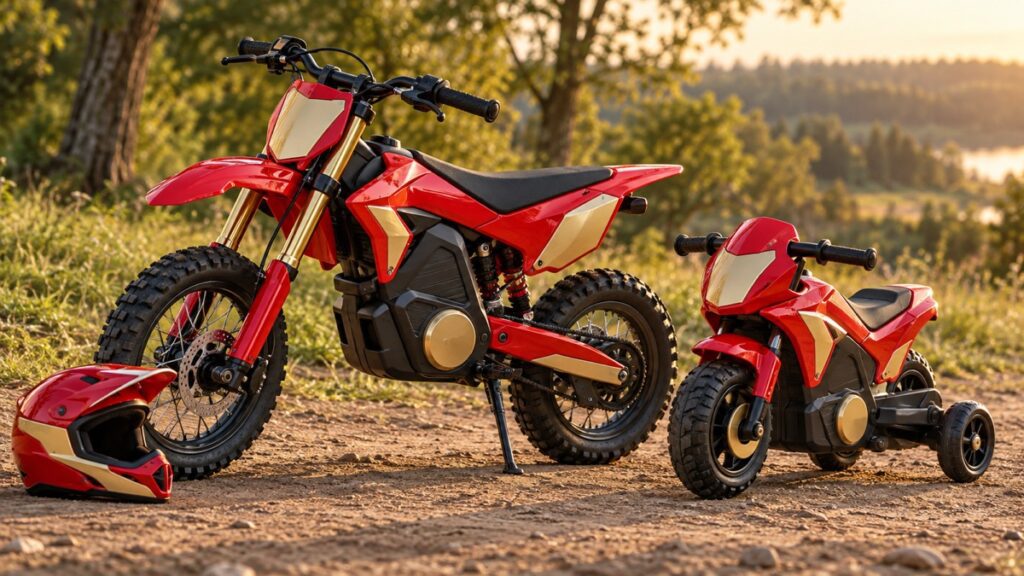
Choosing a kids’ electric dirt bike starts with one question: can your child already balance on two wheels? If not, start with a 12V motorcycle-style ride-on that has training wheels and a low top speed. If your child is a confident two-wheel rider and old enough for the listed age range (8–12 on the 24V dirt bike in our range), a 24V bike with a throttle, air-filled tires and suspension is the step up. Then check the listed age, weight limit and speed against your child.
The term “electric dirt bike” covers very different machines, from a toddler motorbike that moves at walking pace to an off-road bike that reaches about 14 mph. This guide explains the types, the specs that matter and how to match one to your child.
Three types of two-wheeled ride-on
Electric dirt bikes are built for off-road riding. They have no balance aids, use a hand throttle and brakes, and run on air-filled tires with suspension. Riders need real two-wheel skills.
Motorcycle-style ride-ons look like sport or motocross bikes but ride on training wheels, move slowly and are meant for smooth surfaces. They suit preschool and early school-age children who want the motorbike look without needing to balance.
Scooter-style ride-ons, such as our licensed Vespa, have a step-through scooter body, a seat and support wheels. They are the gentlest option and suit the youngest riders on flat ground.
The models in our range compared
| Model | Type | Listed age | Listed speed | Balance aid | Controls | Wheels |
|---|---|---|---|---|---|---|
| 24V Electric Dirt Bike | Dirt bike | 8–12 | Up to 14.29 mph | None mentioned | Throttle and brakes | 12-inch inflatable |
| 12V D7 Superpower | Motorcycle-style | 3–8 | 3–5 mph | Training wheels | Foot pedal accelerator | EVA soft wheels |
| 12V R3 Super | Motorcycle-style | 3–7 | Not stated | Dual training wheels | Handlebar speed control, foot brake, direction lever | Anti-skid tires |
| 12V HMX609 | Motorcycle-style | 1–14 (up to 50 kg) | 2.5–4.5 km/h (about 1.5–2.8 mph) | Training support | Simple controls | Light-up wheels |
| Licensed Vespa 12V | Scooter-style | 2–5 | Low speed (not stated) | Support wheels | Foot pedal, forward/reverse switch | Not stated |
Two things stand out. Only one model is a true off-road dirt bike, and it starts at age 8. The other four are training-wheel ride-ons whose listings point to indoor floors, driveways and smooth outdoor surfaces, not dirt tracks.
Training wheels or none: the balance question
Training wheels hold the bike upright, so a young child can focus on steering and speed. The trade-off is that they work best on flat, smooth ground, and that is exactly where the listings for the D7, R3, HMX609 and Vespa say these models should ride. On bumpy or sloping ground, a training-wheel bike can rock between its wheels instead of rolling smoothly.
The 24V dirt bike’s listing does not mention training wheels. Treat it as a bike for children who can already ride a pedal bike confidently, start, stop and turn without help, and put a foot down when they come to a stop.
Foot pedal vs hand throttle
How the bike accelerates matters as much as how fast it goes.
- Foot pedal (D7, Vespa): press to go, lift to slow down. For a young child this is the most natural control, because letting go is the instinctive reaction when something feels wrong.
- Handlebar speed control (R3 Super): speed is set at the handlebar, with a separate foot-pedal brake. It is a useful middle step that teaches the throttle-and-brake idea at low speed.
- Throttle and brakes (24V Dirt Bike): this is how real motorbikes work. A startled beginner may grip harder instead of letting go, so practise slowing down and stopping in an open space before riding anywhere else.
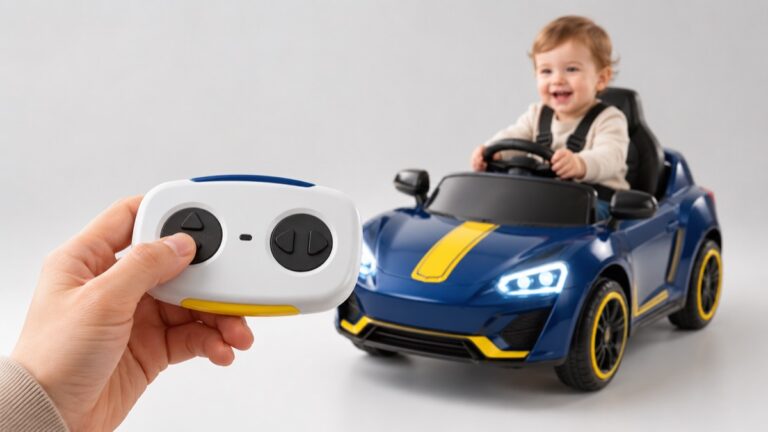
Unlike many of our ride-on cars and jeeps, none of the bike listings in our range mention a parental remote. Your main safety tools are the speed cap, the riding space you choose, and staying close by.
Voltage and speed
The 12V bikes are tuned for low, steady speeds, from walking pace on the HMX609 up to 5 mph on the D7. The 24V dirt bike’s listed top speed of 14.29 mph puts it in a different category. At that speed, braking distance, protective gear and a clear riding area matter much more. The higher voltage also explains why it can handle dirt and uneven ground, where a 12V training-wheel bike would bog down. Our 12V vs 24V guide explains the power difference in more depth.
Tires: why they decide where the bike can go
The 24V dirt bike’s 12-inch inflatable tires grip dirt and grass and absorb bumps before they reach the frame. That is what makes off-road riding possible. Like any air-filled tire, they need their pressure checked and can puncture. The EVA soft wheels on the D7 and the anti-skid tires on the R3 grip better than hard plastic on floors and driveways, but they are not off-road tires. Our guide to rubber tires vs plastic wheels explains the grip and noise differences.
Age, size and weight fit
- Use the listed weight limit where there is one. The 24V dirt bike supports up to 132.2 lbs and the HMX609 up to 50 kg (about 110 lbs). The D7, R3 and Vespa listings don’t state a weight limit, so ask us before buying for a heavier child.
- Read wide age ranges with care. The HMX609’s 1–14 range reflects its very low speed and training support. An older child may find it too small or too slow long before they reach 14.
- Check the fit in person if you can. Seat heights aren’t listed for these models. On the 24V dirt bike, your child should be able to reach the handlebars and controls comfortably and steady the bike with their feet when stopped.
For a broader look at sizing, see what age a ride-on is for.
Protective gear
A helmet is the one piece of gear every rider should wear. In the U.S., bicycle helmets must meet the Consumer Product Safety Commission’s safety standard, so look for the CPSC certification label inside the helmet, and make sure it fits snugly and sits level on the head. For the 24V dirt bike, add gloves, knee and elbow pads, long sleeves and trousers, and sturdy closed-toe shoes. Even on the slow training-wheel bikes, closed-toe shoes are sensible because feet are close to the wheels and the ground. Our safety checklist covers supervision and where to ride.
Which bike fits your child?
- Toddler or preschooler wanting a first “motorbike”: the Licensed Vespa 12V (2–5) for a scooter style, or the HMX609 for a motorcycle look at very low speed.
- Ages 3–8 wanting a sport-bike look: the D7 Superpower (3–5 mph, foot pedal) or the R3 Super (handlebar speed control, listed runtime up to 2 hours).
- Confident two-wheel rider aged 8–12 with a yard or trail to ride on: the 24V Electric Dirt Bike.
- Child who wants off-road riding but can’t balance yet: a quad may suit them better than a bike. Our kids’ ATV buying guide covers the options.
Frequently asked questions
How long does a kids’ electric motorbike battery last?
It depends on the model and how it’s ridden. The D7 Superpower lists 45–60 minutes of runtime, and the R3 Super lists up to 2 hours with a 3–4 hour charge. The HMX609 lists a 6–9 hour charge. The 24V dirt bike’s listing doesn’t state a runtime. Our battery and charging guide explains what shortens runtime and how to charge safely.
Is an electric dirt bike or an electric scooter better for my child?
A dirt bike suits a child who wants to ride on dirt and grass and can handle a throttle. A stand-up electric scooter suits paved paths and getting around. Our kids’ electric scooter buying guide covers how to size and choose one.
Can the training-wheel bikes go on grass?
Their listings describe indoor floors, driveways and smooth outdoor surfaces, and the Vespa’s listing says grass, gravel and rough ground are not ideal. For regular grass riding, the 24V dirt bike or a 4×4 quad is a better match.
See the bikes in person
Browse all our ride-on motorbikes and electric dirt bikes, or bring your child to our Douglasville, Dawsonville or Stonecrest store to check the fit before you buy.
Shopping for Christmas? See our ride-on gift picks by age & budget — order by Dec 5 for shipped delivery, or pick up free in Douglasville, Dawsonville or Stonecrest. Black Friday deals →