Some ride-on cars can go on gravel and gentle hills, but most standard models shouldn’t. A 4×4 ride-on jeep, UTV or quad with grippy tires and enough power can handle firm dirt, light gravel and mild slopes with an adult nearby. A typical low ride-on car with hard plastic wheels is built for pavement and smooth floors. On loose gravel, sand or a real hill it is likely to spin, stall and strain its motors and gearbox. The quickest check is to see which surfaces the model’s listing names.
Surface by surface: what to expect
| Surface | What happens | What copes best | Main risk |
|---|---|---|---|
| Pavement, driveways, patios | Every ride-on is designed for this | Any model | Driveway slopes and nearby traffic |
| Short grass | Rolling resistance rises, so the motors work harder | Rubber or EVA tires, 24V or 4×4 | Stalling and fast battery drain |
| Packed dirt | Usually fine if dry and firm | 4×4 jeeps, UTVs and quads | Dust getting into moving parts |
| Gravel | Small wheels dig in or skid; stones jolt the drivetrain | 4×4, larger tires, suspension | Gearbox shock, stones jammed in wheel wells |
| Sand | Wheels sink and spin | Few ride-ons; short sessions only | Fine grit in axles and gears |
| Slopes and hills | Climbing loads the motors; descending builds speed | Gentle slopes only, ideally with a parental remote | Tipping sideways, runaway speed |
| Wet ground, puddles, rain | Traction drops and water reaches the electrics | None. Avoid it | Electrical damage, slipping |
Grass gets a guide of its own: our guide to the best ride-on cars for grass covers lawns in detail. The rest of this article covers the harder surfaces.
Gravel: why it is harder than it looks
Loose gravel moves under the wheels. A narrow, hard plastic wheel can’t push through it. It either digs a hole and spins, or skids across the top. Each time a stone blocks a wheel and then suddenly releases it, the shock goes back through the gearbox to the motor. This is the kind of repeated load that wears drivetrains early.
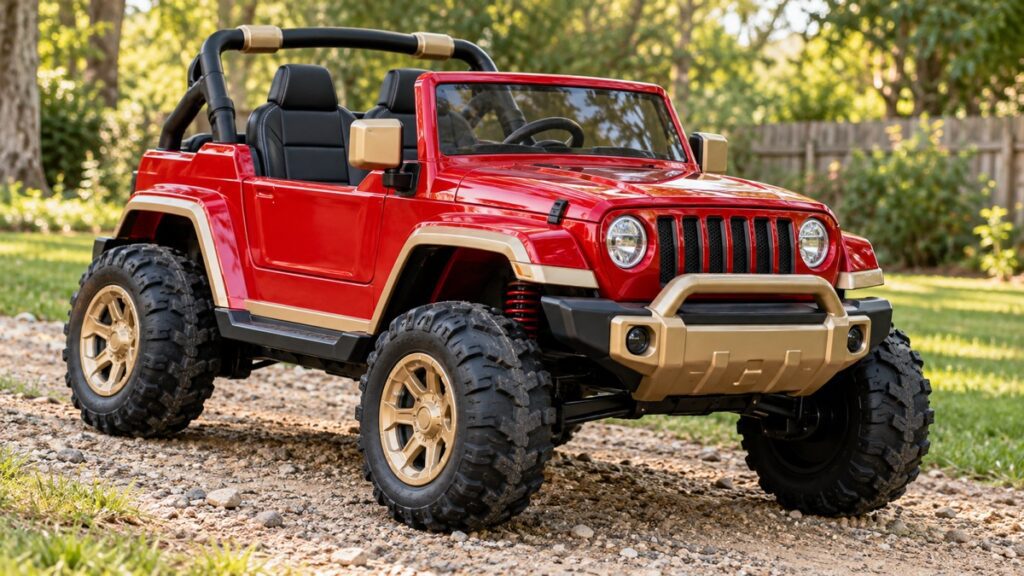
Light, compacted gravel on a firm base is a different matter from a deep, loose driveway. A 4×4 vehicle with wider, grippier tires and suspension copes much better, because power goes to all four wheels and the suspension keeps them in contact with the ground. In our range, the 24V Utv-Mx Ride-On Jeep is the model whose listing names light gravel alongside grass and dirt. Deep or loose gravel is best avoided whatever you drive.
Dirt and sand
Dry, packed dirt paths are usually manageable for 4×4 jeeps and quads. Soft dirt, mud and sand are harder. The wheels sink, the motors work against constant resistance, and fine particles get into wheel axles and gears, where they act like grinding paste. The 24V 2129 4×4 ATV lists sand among the surfaces its 4×4 system grips. Even so, keep sand sessions short and clean the vehicle afterwards.
Hills and slopes
Climbing is where weight, power and drive layout matter most. The motors have to lift the vehicle and the rider as well as move them forward, so they draw more current, heat up and drain the battery faster. If a ride-on slows to a crawl or stalls on a slope, it is working beyond its comfortable load. Holding the pedal down while it struggles stresses the motor and gearbox.
Going down is the safety concern. Speed builds on a descent, and many children’s ride-ons don’t have a separate brake. Among the vehicles in our range, the Hyper GoGo quad lists a rear disc brake, yet its listing still says it is not built for steep climbs or wet surfaces. The licensed Dodge Ride-On Car listing says to avoid steep slopes.
Safer slope habits
- Use gentle slopes only, and start on the lowest speed setting.
- Drive straight up and straight down. Driving across a slope makes a sideways tip far more likely.
- Stay within reach, or keep the parental remote in hand if the model has one. The 1928 4X4 UTV Clash, Utv-Mx and 24V Ford Truck list a remote emergency stop, and the Can-Am lists a remote emergency brake.
- Keep slopes well away from streets, pools, ditches and drop-offs.
- If the vehicle stalls on a slope, have the child release the pedal and help the vehicle down or across to level ground, rather than letting them keep trying.
- Stay within the listed rider weight limit. Extra weight on a hill multiplies the load on the motors.
Wet ground, puddles and rain
Keep ride-ons out of the rain and away from puddles. Water reduces grip on every surface, and these vehicles run on a battery, wiring, switches and motors that should be kept dry. If a ride-on does get wet, switch it off, dry it thoroughly, and don’t charge it until the battery area is completely dry. Store it under cover. Our maintenance and storage guide covers keeping it clean, dry and stored safely.
Why weight, voltage, 4×4 and tires matter
- Drive layout: a two-wheel-drive ride-on stops pushing as soon as its driven wheels lose grip. With 4×4, the other wheels keep pushing. Four-motor designs, such as both Mercedes Unimogs and the 48V Can-Am, also spread the work across four motors instead of one or two.
- Voltage and motor power: a higher-voltage system can deliver more power for the same job, which helps on climbs and soft ground. Real-world results still depend on the motors, gearing and total weight. The 12V vs 24V guide explains the trade-offs.
- Tires: rubber, EVA and air-filled tires grip loose surfaces far better than hard plastic, which slides and wears quickly on gravel. See rubber tires vs plastic wheels.
- Weight: a heavier vehicle presses its tires into the ground for traction, but it is also more mass to carry uphill. That is one reason a light, low-powered car fades on a slope that a heavier 4×4 can climb.
- Ground clearance and suspension: the Unimogs’ raised suspension lifts the body clear of bumps and stones. A low car’s underside can catch on them.
Which vehicles in our range suit rougher ground?
These descriptions come from each product’s listing:
- 12V Mercedes Unimog and 24V Mercedes Unimog — four-motor 4×4 with raised suspension, described for grass, dirt and uneven or rough surfaces.
- 24V 1928 4X4 UTV Clash and the 24V Utv-Mx — 4X4 drive with shock absorbers, for grass, dirt and rough ground; the Utv-Mx also names light gravel.
- 48V Can-Am Ride-On Jeep — four 200W motors, described for grass, dirt and uneven ground.
- 24V J618 4×4 ATV and the 24V 2129 — 4×4 quads with EVA tires, described for grass and light trails; the J618 also names dirt and the 2129 names sand.
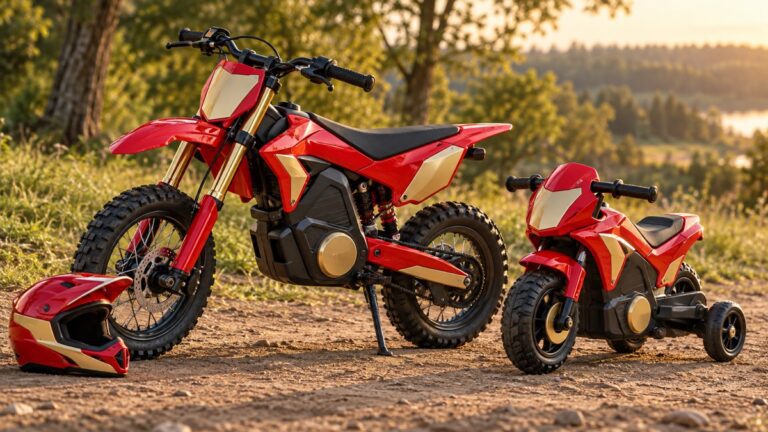
- 24V Electric Dirt Bike — 12-inch inflatable tires and suspension, for dirt tracks, grass and uneven ground (listed for ages 8–12).
Better kept to smooth surfaces: the Licensed Vespa 12V scooter, whose listing says rough ground, grass, gravel and steep surfaces are not ideal, and most low licensed sports and luxury cars, whose listings describe tiles, pavement and driveways. Browse the ride-on jeeps and trucks and ATV collections for the off-road models.
Cleaning up after rough ground
- Switch the vehicle off before you start.
- Brush or wipe off dust, sand and mud, especially around the wheels and axles.
- Pick out any stones caught in the wheels or wheel wells.
- Wipe the body with a damp cloth. Don’t hose it down or use a pressure washer.
- Check that the wheels turn freely and that the wheel nuts and fittings are still tight.
- Let everything dry fully before charging or storing.
Frequently asked questions
Can a 12V ride-on car go up a hill?
A 12V ride-on can usually manage a slight incline on a firm surface, but it will slow down, and a real hill is often too much, especially with a heavier child. Drive layout matters too. The 12V Mercedes Unimog in our range uses four motors for 4×4, which suits uneven ground far better than a two-wheel-drive 12V car.
Can I take a ride-on to the beach?
It isn’t recommended. Soft sand makes most ride-ons sink and stall, and sand, salt spray and water are hard on the axles, gears and electrics. If you do use one on a firm sandy path, keep it short and clean the vehicle thoroughly afterwards.
What should I do if the ride-on keeps stopping on rough ground?
Move it to a flatter, firmer surface and let it rest. Repeated stalling means the vehicle is overloaded for that surface. If it also cuts out on flat ground, the battery may need charging or checking. Our battery and charging guide explains what to look for.
Not sure whether a model will cope with your yard? Describe your ground when you contact us, or bring the question to our Douglasville, Dawsonville or Stonecrest store.
Shopping for Christmas? See our ride-on gift picks by age & budget — order by Dec 5 for shipped delivery, or pick up free in Douglasville, Dawsonville or Stonecrest. Black Friday deals →