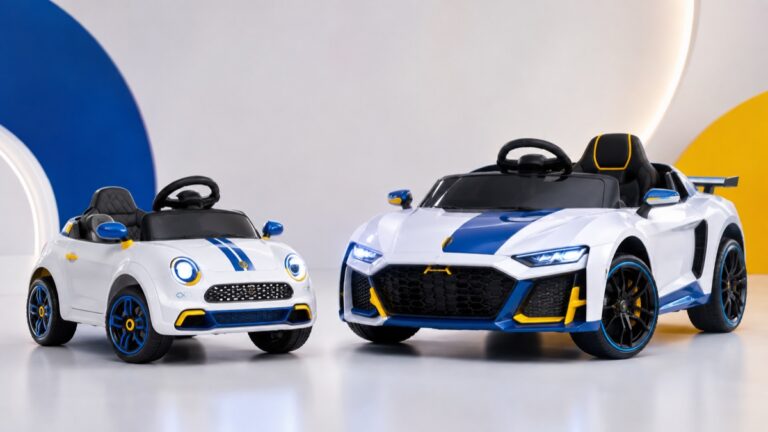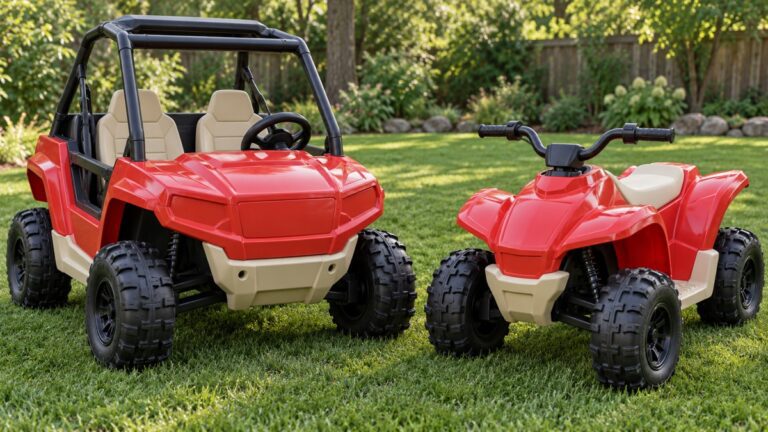
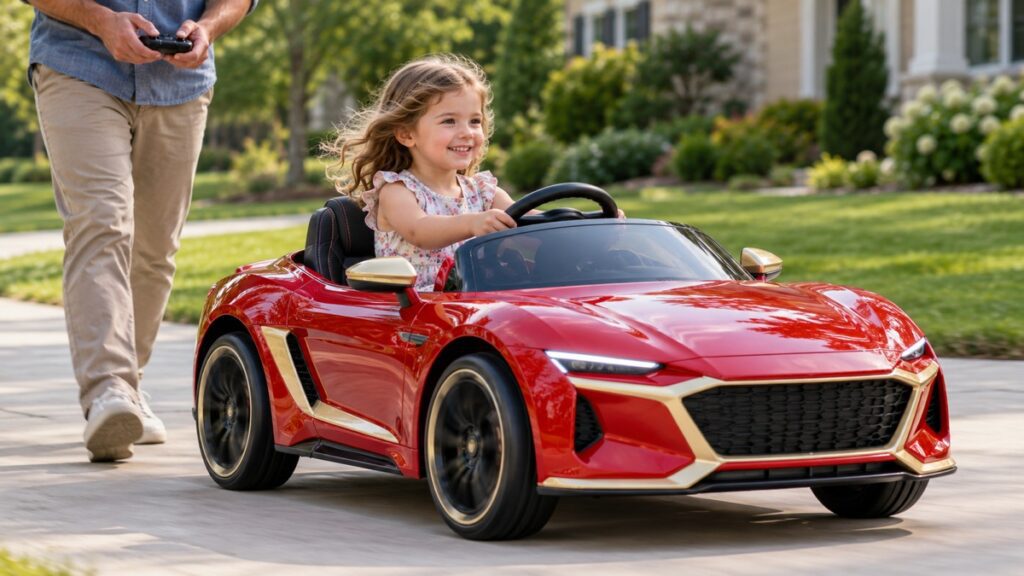
Most kids’ electric ride-on cars go between about 1 and 5 mph, which is roughly walking pace up to a slow jog. Among the models in our current range that list a speed, the 12V cars run from 1.24–2.8 mph (12V Maserati) up to 3–5 mph (12V Licensed Lamborghini), and the two-seat 24V Range Rover reaches up to 5 mph. Ride-ons built for older kids are faster. Our youth ATVs, drift go-karts and dirt bikes list speeds from about 5 mph up to 14.29 mph, and the 48V twin-seat go-kart, listed for riders 8 and up, reaches up to 25 mph.
The exact speed depends on more than the battery, so the rest of this guide covers what changes speed, which controls let a parent limit it, and how to match it to your child.
Listed speeds by vehicle type
The table below includes only models whose listing gives a speed. Many ride-ons, including several of our 24V jeeps and UTVs, don’t publish a number. For those, the speed settings and listed age range are the best guide, or you can call and ask about a specific model.
| Model | Type | System | Listed speed | Speed control | Listed age |
|---|---|---|---|---|---|
| 12V Maserati | Ride-on car | 12V 4.5Ah | 1.24–2.8 mph | 2.4G parental remote | 3–6 |
| 12V Mercedes Benz AMG | Ride-on car | 12V, dual 30W motors | 1.8–3.2 mph | 2.4G parental remote | 3–6 |
| 12V Licensed Lamborghini | Ride-on car | 12V | 3–5 mph | Parental remote | 3–6 |
| 12V Mercedes Unimog | Ride-on jeep, 4×4 | 12V, four motors | 3–5 mph | Speed regulated | 3–8 |
| 24V Range Rover | Two-seat SUV | 24V 7Ah, dual 240W motors | Up to 5 mph | 2–3 speed levels, slow start, remote | 3–8 |
| 12V D7 Superpower Bike | Motorbike with training wheels | 12V | 3–5 mph | Foot pedal | 3–8 |
| 24V 2129 4×4 ATV | ATV | 24V | 5–8 mph | Foot pedal plus parental remote | 3–7 |
| McLaren 24V Drifting Go-Kart | Drift go-kart | 24V 10Ah | About 4–7.5 mph | Two forward speeds | 6–12 |
| 24V Drift Kids Go-Kart | Drift go-kart | 24V, dual 200W motors | Up to 8.5 mph | Low and high speed | 5–13 |
| 36V Hyper GoGo Quad ATV | Sport ATV | 36V, 350W | 3.1 / 5 / 10 mph by mode | App-selected Kids, Normal and Sports modes | 12+ |
| 24V Drifting Gokart | Drift go-kart | 24V, dual motors | 8–12 mph | Low and high modes, slow start | Around 12 |
| 24V Electric Dirt Bike | Dirt bike | 24V | Up to 14.29 mph | Throttle | 8–12 |
| 48V Twin Seater GoKart | Two-seat go-kart | 48V | Up to 25 mph | 3 speeds, parental speed lock, key start | 8+ |
Two patterns stand out. Every car-style ride-on in the table listed for ages 3–6 tops out at 5 mph or less. Speeds above about 8 mph only appear on go-karts, ATVs and dirt bikes listed for older riders, and those come with features such as two or three speed modes, slow start or a parental speed lock.
What those speeds feel like
An adult walks at roughly 3 mph. At that speed a ride-on covers about 4.4 feet every second, so a parent walking beside a 12V car on its low setting can keep up easily. At 5 mph it’s about 7.3 feet per second, which is faster than most parents walk, so to stop the car quickly you need the remote rather than your own legs. At 8 mph it’s about 11.7 feet per second, and at 12 mph about 17.6 feet per second. That’s why the faster karts and ATVs need a large, open, flat area and a rider who can steer and brake on their own.
Why voltage alone doesn’t decide speed
It’s easy to assume a 24V ride-on is twice as fast as a 12V one. Our own listings show it isn’t that simple. The 12V Licensed Lamborghini lists 3–5 mph, and the much larger 24V Range Rover lists up to 5 mph. Among the big go-karts, the 60V 2000W twin-seater lists up to 18.7 mph, while the 48V twin-seater lists up to 25 mph. Speed comes from the whole drive system:
- Motors and gearing. The motor’s output and the gearbox ratio decide how much of the battery’s power turns into wheel speed and how much into pulling force. A ride-on geared for torque climbs and carries load better but has a lower top speed.
- Weight carried. A two-seater with two children, or a child near the weight limit, moves more slowly than the same car with one light rider. The 24V Drift Kids Go-Kart listing notes that rider weight, charge level, surface and slope all affect its actual speed.
- Surface and slope. Smooth pavement gives the highest speed. Grass, gravel and uphill driving all slow a ride-on down and make the motors work harder.
- Battery charge. A fully charged battery delivers its best speed. As the charge runs down, or as the battery ages, the car slows. Our ride-on battery and charging guide explains why.
Extra voltage mostly buys power under load: carrying a second rider, handling grass or keeping speed on a gentle slope. If you’re deciding between the two systems, our 12V vs 24V ride-on cars guide compares them in detail.
How parents can control the speed
Speed settings
Many ride-ons have two or three speeds. The licensed Dodge ride-on car and the 12V Mini UTV list three speed modes. The 24V Mercedes Unimog lists two. Settings let one car grow with a child: start on low, and move up only once they steer, stop and reverse confidently on low.
Parental remote and emergency stop
A 2.4G parental remote lets an adult steer, stop, and on many models choose the speed. Some listings also name a dedicated emergency stop or brake on the remote, including the 12V Mou Mou, 24V UTV-MX, 24V Ford Truck and 48V Can-Am. For a child under about 5, the remote matters more than the car’s top speed, because it lets you stop the car from where you stand. Our parental remote ride-on cars guide covers how remotes work and what to check.
Soft start
Soft start (also called slow start or safe start) doesn’t lower the top speed. It makes the car pick up speed gradually instead of jerking forward when the pedal is pressed. That stops a young driver being thrown back in the seat and panicking. Several models in our range list it, including the 12V Mou Mou, 12V BMW, 12V Mercedes Maybach, 24V Range Rover and 24V UTV-MX.
Lockouts on faster machines
On the faster go-karts and ATVs, the important control is a way to keep the top speed locked away. The 48V Twin Seater GoKart has a parental speed lock and key start. The Hyper GoGo Quad ATV uses an app to set Kids mode (3.1 mph), Normal mode (5 mph) or Sports mode (10 mph). Low modes on the drift karts limit acceleration until the rider is ready. If a faster machine has no way to limit speed, it’s only suitable for a rider who is already confident at full speed.
What speed is right for your child’s age?
No single safety rule ties a speed to an age. The most reliable guide is the manufacturer’s listed age range and weight limit for each model, together with your child’s own coordination. Our listings group roughly like this:
- Toddlers (about 2–4): bumper cars and the gentlest ride-ons, described as low-speed but usually without a published mph figure. A parental remote is the key feature at this age.
- Ages 3–6: 12V cars in the 1–5 mph band, ideally used on the lowest setting with the remote in an adult’s hand.
- Ages 3–8: 24V cars, jeeps and UTVs, with multiple speed settings so the child can start slow and move up.
- Ages 5–13: drift go-karts in roughly the 4–12 mph range, for kids who can steer, brake and follow instructions on their own.
- Ages 8 and up: dirt bikes and larger go-karts with higher listed speeds, ideally with a speed lock and a helmet.
Whatever the speed, ride on a flat area away from streets, driveways with traffic, pools and slopes, with an adult watching. The 24V Drift Kids Go-Kart listing specifically calls for a helmet, closed-toe shoes and adult supervision, and that’s sensible for any kart, ATV or bike. Our ride-on car age and size guide covers fit and weight limits, and the ride-on safety checklist covers where and how to ride.
Can you make a ride-on car faster?
We don’t recommend it. Fitting a higher-voltage battery than the car was designed for pushes more current through motors, wiring and switches that weren’t built for it. That can overheat parts or damage the gearbox, and it removes the speed limits the manufacturer set for the listed age range. If your child has outgrown their car’s speed, a safer step is a model designed for a higher speed, with its own brakes, frame and speed controls to match.
Frequently asked questions
Why is my ride-on slower than its listed speed?
Listed speeds assume a full charge, a rider within the weight limit and a smooth, level surface. Grass, slopes, a second passenger, a low or ageing battery, or a low speed setting all reduce speed. If the car has suddenly slowed when it used to be quicker, the battery is the first thing to check — our battery and charging guide explains how charge level and battery age affect performance.
Is a ride-on car faster on grass or pavement?
On pavement. Grass resists the wheels, so the same car moves more slowly and uses more battery. Wheel type and drive layout make a real difference off pavement. Our guide to the best ride-on cars for grass explains what helps.
Does a parental remote override the child’s pedal?
On dual-control models, the listings describe the remote as able to take over steering and movement when needed, and some include an emergency stop. Exactly how the handover works varies by model, so check the manual. Test the remote’s stop function before the first ride.
See speeds and settings in person
If you’re comparing, browse our 12V ride-on cars for the gentlest speeds, or 24V ride-on cars and ride-on jeeps and trucks for multi-speed models. To feel the difference between speed settings before you buy, visit our Douglasville, Dawsonville or Stonecrest store for a test drive.
Shopping for Christmas? See our ride-on gift picks by age & budget — order by Dec 5 for shipped delivery, or pick up free in Douglasville, Dawsonville or Stonecrest. Black Friday deals →