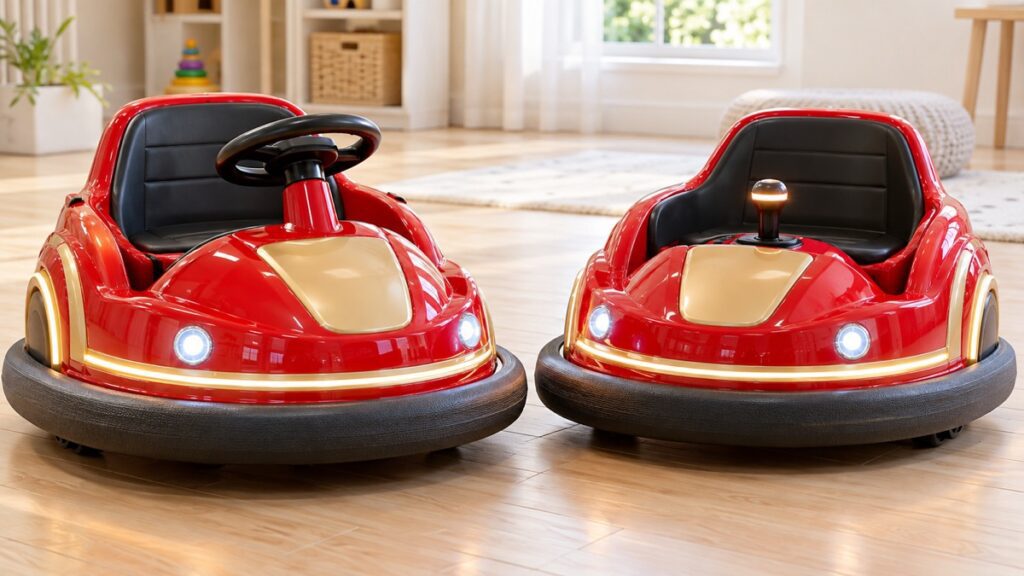
A kids’ bumper car is a small ride-on that spins in place and is surrounded by a soft bumper, so a toddler can turn, nudge into things and change direction without the long straight runs a ride-on car needs. In our current range there are two: the Bumperz 6V bumper car, listed for ages 2–4, and the 12V 360-degree spin bumper car, listed for ages 2–3 with a joystick and a parent remote. The right one depends less on voltage than on how your child steers and whether you want to be able to take over.
Is a bumper car the right first ride-on?
A bumper car suits a child who mostly plays in a small area: a playroom, a garage, a patio or a short stretch of driveway. Because it rotates on the spot, it doesn’t need a turning circle, and because the whole body is ringed by a padded bumper, contact with walls and furniture is part of the play rather than a crash.
It is a weaker fit if your child wants to drive across the yard or down the street. Both listings recommend smooth, level surfaces, and neither is described as a grass or gravel vehicle. For outdoor driving on lawn, a ride-on with rubber tires and more ground clearance makes more sense; our guide to ride-on cars for grass covers that.
If you are still deciding whether your child is ready for any powered ride-on, our ride-on age and size guide explains what to look for beyond the age printed on the box.
6V Bumperz vs 12V spin bumper car at a glance
| Feature | Bumperz 6V | 12V 360-degree spin |
|---|---|---|
| Listed age | 2–4 years | 2–3 years |
| Listed max rider weight | 66.13 lbs | 66 lbs |
| How the child drives | Steering wheel and control panel, forward and reverse | Joystick (rotates in place), with pedal-controlled power |
| Parent remote | Not mentioned in the listing | Yes, can override the child’s control |
| Protection | Anti-collision bar and soft bumper, adjustable seat belt, forward overturn protection | Full soft bumper ring, safety belt |
| Tires | Not specified | Anti-flat tires |
| Size | Not listed | 26.5 × 26.5 × 17 in |
| Extras | LED lights, music and stories, power indicator with low-battery alert | LED lights, music with USB/AUX and story modes, small leisure board for toys or snacks |
Two things in that table surprise most parents. First, the higher-voltage model is listed for the narrower, younger age band (2–3), while the 6V Bumperz runs to age 4. Second, the weight limits are almost identical. So the 12V is not a “bigger kid” version; the real difference is the control system.
Joystick vs steering wheel: which suits your child?
The 12V car uses a joystick. Pushing it in a direction rotates the car in place, so a small movement of the hand produces an immediate, visible result. For a two-year-old, that cause-and-effect link is easy to grasp, and it explains why the listing focuses on hand coordination. The trade-off is that joystick control feels different from a car, so it teaches less about steering as such.
The Bumperz uses a steering wheel with a simple control panel and forward/reverse. That is closer to how a ride-on car works, which can help if you expect to move up to a 12V car later. It still spins a full 360 degrees, but the child has to coordinate the wheel and controls rather than point a stick.
A practical way to decide: if your child is at the younger end and gets frustrated easily, the joystick’s directness is an advantage. If they already like turning a toy steering wheel or are closer to three or four, the Bumperz’s layout gives them more to grow into within its listed age range.
Do you need a parent remote?
Only the 12V spin bumper car lists a parent remote. It lets you take over movement at any moment, which matters in two situations: when your child hasn’t yet learned to stop on their own, and when you are using the car somewhere with other children, pets or hazards nearby. You can let them drive and still stop the car before it reaches the stairs or the dog.
If you’ll mostly be sitting right beside a toddler in an enclosed room, a remote is less critical, and the Bumperz’s simpler setup may be enough. Our guide to parental remote ride-on cars explains how remote override generally works and when it is worth prioritizing.
Indoor vs outdoor: which surfaces work
Both listings point to the same conditions: smooth and level. The Bumperz listing names indoor flooring, garages, patios, driveways and flat outdoor surfaces. The 12V listing names indoor floors, driveways and play mats, and its anti-flat tires are designed to keep their shape and roll evenly on those.
What that means in practice:
- Good: hard floors, a clear garage, a level patio or driveway, firm play mats.
- Check first: thick or shaggy rugs, which add resistance; neither listing names carpet as a recommended surface.
- Avoid: grass, gravel, slopes, and anywhere near a pool, steps or a street. Small wheels and low-speed power aren’t built for these, and a slope changes how a spinning car behaves.
How much space does a bumper car need?
Less than any other ride-on, because it doesn’t need room to turn. The 12V model’s footprint is 26.5 inches square, about the size of a small side table, so it fits through most interior doorways and doesn’t need a garage spot. The Bumperz’s dimensions aren’t listed, so check with us if storage space is tight.
The car spinning in place is only part of the picture. Children rarely just spin; they drive, spin, back up and drive again. Clear a space with room to travel a few car-lengths in each direction, move fragile items and floor lamps out of the way, and keep it away from stairs. The bumper softens contact with furniture, but it isn’t a reason to drive into a crowded room.
Safety features that matter in a bumper car
- Seat belt: both models have one. It matters more in a bumper car than in a car that only drives forward, because spinning and sudden direction changes push a small child sideways. The Bumperz belt is adjustable to fit riders within the age range.
- Bumper ring: a soft bumper that surrounds the whole car spreads the force of contact rather than concentrating it, protecting both the child and your walls.
- Overturn protection: listed on the Bumperz, which also has a wide bumper structure and balanced wheel layout intended to reduce tipping when a child accelerates, stops or turns.
- Low, controlled speed: both are described as low-speed, with power that builds gradually rather than jumping. Neither listing gives a top speed in mph.
- Supervision: no feature replaces an adult in the room. Our ride-on safety checklist covers pre-ride checks and house rules that apply to bumper cars too.
Battery and charging
Neither listing states a runtime or charging time, so we won’t guess one. Runtime on any small ride-on depends on rider weight, surface and how much the child spins versus drives. The Bumperz has a power indicator and a low-battery alert, which helps you plan a recharge before the car slows mid-play. For general charging habits that extend battery life, see our ride-on battery and charging guide.
Which bumper car should you choose?
- Choose the 12V 360-degree spin bumper car if your child is around two, you want the option to take control with a remote, and you like the idea of joystick driving in a small room. Its listed size also makes storage easy to plan.
- Choose the Bumperz 6V if your child is closer to three or four, enjoys a steering wheel, and you’ll be supervising close by. Its listed age range runs a year longer and it includes a low-battery alert and overturn protection.
Both are shown in our bumper car collection, with current colors.
Frequently asked questions
Can a 1-year-old use a kids’ bumper car?
Both bumper cars in our range are listed from age 2. Below the listed age, a child may not sit securely or understand the controls, so it’s better to wait or start with a push car that an adult steers.
Can two bumper cars bump into each other?
They are designed for contact: the soft bumper ring absorbs impact from walls, furniture and objects. If two children are driving at once, use a clear, open space, keep both belted, and stay close enough to step in. The 12V model’s parent remote makes this easier to manage.
Is 12V faster than 6V in a bumper car?
Not necessarily in a way that matters here. Both are described as low-speed, and neither listing gives a top speed. The bigger difference between our two models is the control system and the parent remote, not the voltage.
See them before you buy
Bumper cars are easy to judge in person: you can see the size and let your child sit in one. Visit our Douglasville, Dawsonville or Stonecrest store, reserve online for free in-store pickup, or have it delivered. We offer free local delivery across metro Atlanta and north Georgia and free shipping across the US.
Shopping for Christmas? See our ride-on gift picks by age & budget — order by Dec 5 for shipped delivery, or pick up free in Douglasville, Dawsonville or Stonecrest. Black Friday deals →