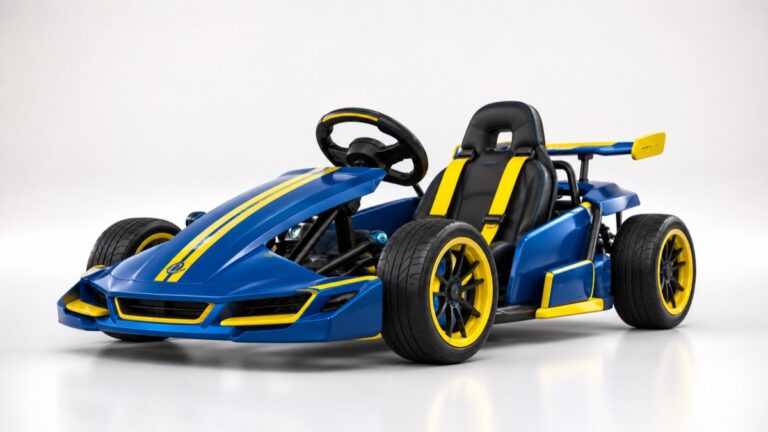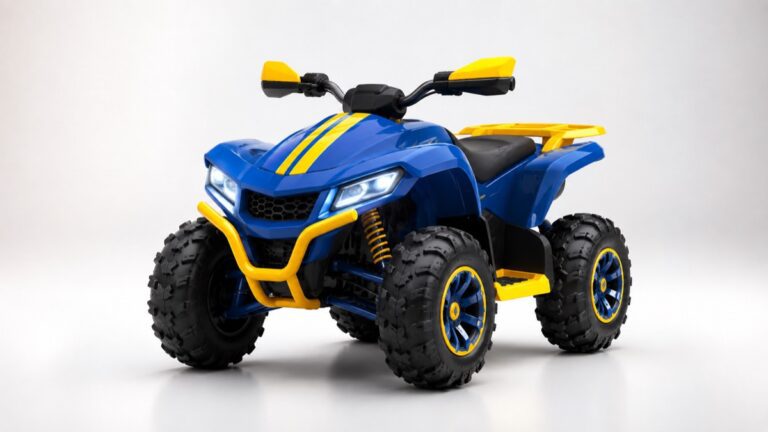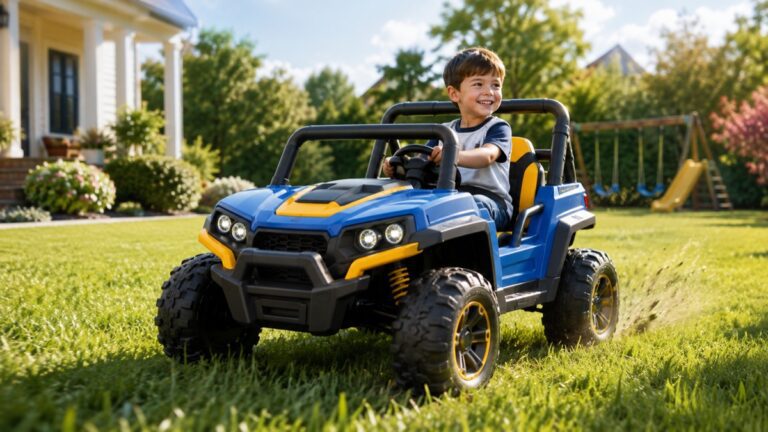
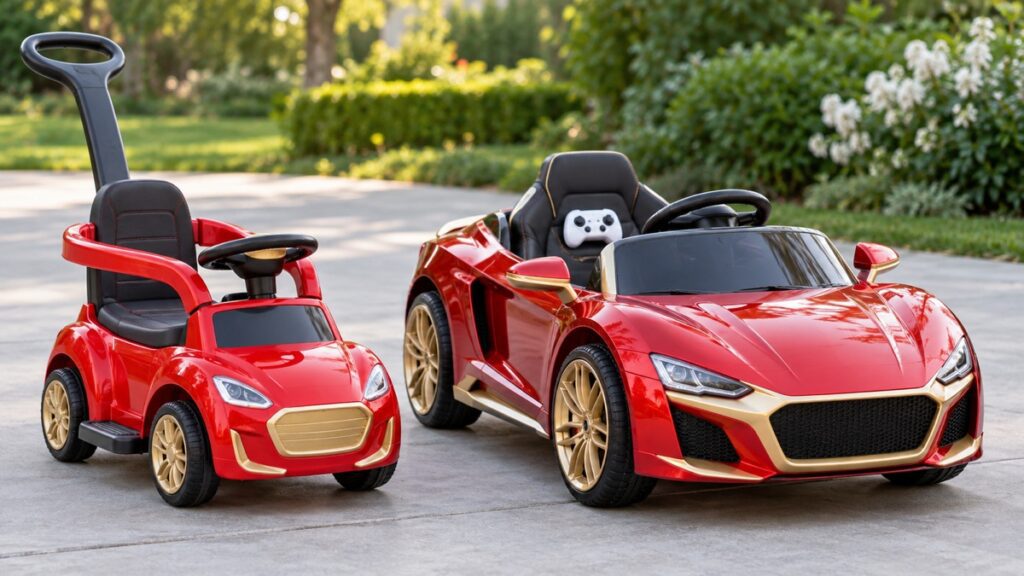
A push car has no motor. An adult pushes it with a handle or the child moves it with their feet, so it suits children from about 12 months to 3 years who are still learning to walk, steer and stop. A ride-on car is battery-powered and the child drives it with a pedal and steering wheel. Most 12V models in our range are listed from age 3. If your child is under 2, choose a push car. If they are 3 or older and can follow “stop” reliably, a powered car with a parental remote is usually the better buy. Between 2 and 3, it depends on the child.
Push car vs ride-on car at a glance
| Push car | Powered ride-on car (12V) | |
|---|---|---|
| What moves it | An adult’s push, or the child’s feet | Battery and electric motor(s) |
| Who controls speed | The person pushing | The car’s speed settings, plus a parental remote on many models |
| Typical listed ages in our range | 12 months to 3 years (one model up to about 7) | Mostly from 3, with upper limits of 6 to 8 |
| Charging | None for movement | Needs recharging between sessions |
| Size and weight | Light and compact. The CAT excavator push car weighs about 6.2 lbs | Larger and heavier. Several have a pull handle and transport wheels for moving them |
| Best surfaces | Smooth floors, patios, sidewalks | Driveways and paths. Grass depends on wheels and power |
| Price tier | Entry level | Higher, and rising with voltage and features |
When a push car is the right choice
A push car makes sense when your child cannot yet be trusted to stop. A toddler cannot go faster than an adult pushes or than their own legs can manage, so there is nothing to override and no battery to run flat. Push cars work indoors, take up little storage space and need no charging routine.
Choose a push car if:
- your child is under 2, or is 2 but still unsteady on their feet;
- you want something to use on walks, with you steering by the handle;
- most of the riding will happen indoors or on a small patio;
- you want to see whether your child enjoys ride-ons before spending more.
Push cars that grow with your child
A convertible push car is the strongest argument for buying a push car first. It covers several stages in one product. You use it as a stroller with the handle and guardrails, then as a walker, then as a foot-powered car once the handle comes off.
- The Mercedes G-Wagon 3-in-1 push car has stroller, walking-car and ride-on modes. It is listed for 12 months to 3 years and children under 40 lbs.
- The BMW 4-in-1 push car adds a rocker mode. Its push handle, hand bars and footrest are removable, and it is listed for ages 1 to 3.
- The Fiat 500 push car has an adjustable parent push bar, a seat belt and an adjustable foot treadle for the stage when the child starts pushing with their feet.
If you want a single foot-powered car with a longer life, the Mercedes Benz push car is listed for roughly 25 to 84 months and up to 50 lbs. See every model in the push cars and strollers collection.
When a powered ride-on car is the right choice
A powered car is worth it once your child wants to “drive” and can understand simple instructions. It keeps older toddlers and preschoolers interested for longer because there is more to do: pedal, steer, change direction and, on many models, play music. The trade-offs are size, the need to charge and a higher price. Speed also stops being set by your child’s legs.
For a first powered car, the parental remote matters more than the brand or the styling. With a remote, an adult can steer and stop the car until the child is ready. Look at the 12V Mou Mou, which has soft start, a remote emergency brake and a rocking mode, and is listed for ages 3 to 8. The 12V Maserati lists a low speed range of about 1.24 to 2.8 mph and is rated for ages 3 to 6. The parental remote guide explains how the override works.
Choose a powered car if:
- your child is 3 or older, or close to it and confident;
- you have a driveway, path or yard where the car can actually be driven;
- you are happy to supervise with the remote at first;
- you have somewhere to store and charge it.
Browse the 12V ride-on cars collection. For the difference between 12V and 24V once your child is older, see 12V vs 24V ride-on cars.
The 2-to-3 overlap: how to decide
Ages 2 to 3 are where push cars and powered cars overlap. Most push car listings in our range end at 3, and most 12V car listings start at 3. Look at what your child can do rather than their age:
- Do they stop when asked? If not, stay with a push car, or choose a powered model with a parental remote and expect to drive it yourself for a while.
- Can they reach and hold a pedal while steering? Have them sit in the car if you can. Both of our Georgia stores have models to try.
- Where will they ride? A small indoor space suits a push car or a compact bumper car. A driveway suits a powered car.
- How close are they to the weight limit? A child near a push car’s limit will outgrow it quickly.
Two powered options in our range are listed specifically for 2-year-olds. The 12V bumper car is listed for ages 2 to 3 and has a parental remote. The 6V Bumperz bumper car is listed for ages 2 to 4. Both move slowly and spin on the spot, so they need little space. Our guide to the best ride-on toys for toddlers covers this stage in more detail.
Do you need both?
Not always. Buying a push car first and a powered car later makes sense if you start around 12 to 18 months. A convertible model will cover the stroller-to-scooting years, and the powered car arrives when your child is ready to drive. If your child is already close to 3 when you buy, going straight to a 12V car with a parental remote and soft start is usually the better value. The push car stage would be short.
Frequently asked questions
Is a push car safer than a ride-on car?
A push car removes motor speed from the picture, which lowers risk for children who cannot stop reliably. A powered car with a parental remote and a low speed setting can also be used safely, but only with adult supervision and within its listed age and weight limits. The ride-on safety checklist covers setup and supervision.
Can an older child use a push car?
Only within the listed weight and age limit. Most push cars in our range are listed to 3 years. The Mercedes Benz push car is the exception, listed to about 84 months and 50 lbs.
Does a “battery powered” push car drive itself?
The product name alone doesn’t tell you. Check the listing for a drive motor, a pedal or forward/reverse controls. If none of these is described, plan on the car being pushed by an adult or by your child’s feet.
Shopping for Christmas? See our ride-on gift picks by age & budget — order by Dec 5 for shipped delivery, or pick up free in Douglasville, Dawsonville or Stonecrest. Black Friday deals →